
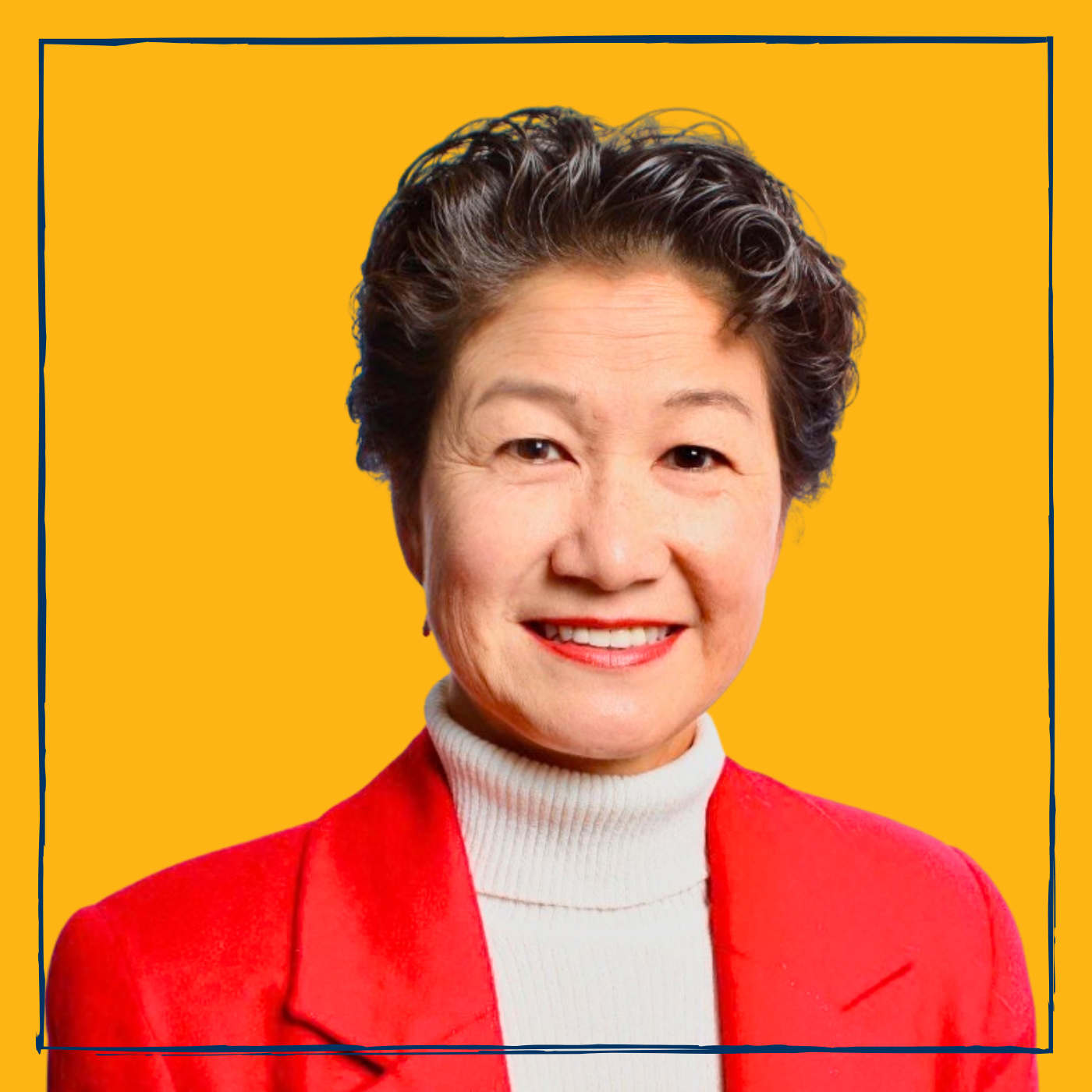


On this episode of OneHaas, learn about the incredible, globe-spanning career journey of alumna Ann Hsu, Founder and Head of School at Bert Hsu Academy. From high tech to yogurt to revolutionizing the approach to public education, this double bear’s story is not one to miss!
Born and raised in Beijing, China, Ann moved to the U.S. with her family at age 11 but has always maintained a strong cultural connection to China. After getting her Master’s degree in electrical engineering from UC Berkeley, she moved back to China and launched into a successful career in high tech. When the need arose to add more business acumen to her skillset, she knew Berkeley Haas was her best option for an MBA.
Ann’s latest career pivot has been into education, where she’s opened the first American-Chinese bicultural school in the U.S., named in honor of her father, Bert Hsu.
Ann joins host Sean Li to discuss the exciting ways they are reimagining education at the Bert Hsu Academy, how her Berkeley degrees have supported her career journey, and her advice for current MBA students and young alumni. She also shares her memories of moving to the U.S. as a young girl in 1978, her family’s history in China, and how her own bicultural experience has shaped her career and worldview.
*OneHaas Alumni Podcast is a production of Haas School of Business and is produced by University FM.*
Episode Quotes:
On her assimilation to American culture
“ I remember a discussion in class and they were talking about china, the bowls and plates. Well, I thought they were talking about the country of China. And I raised my hand, I said, ‘I’m from China.’ Yes, I knew the word, but I didn’t know that we were talking about plates and bowls china and not the country of China. That’s what I mean by cultural assimilation or Americanization. It took me four years.”
On where the idea for a Chinese-American bicultural school came from
“ I thought back to my own experience of going to school in China and the U.S. and then watching my sons go to school in China …and about what’s good about the Chinese education approach, what’s good about the American ones, what’s bad about each. And I thought, I want to combine the Chinese education philosophy, approach and practices with the American ones because both have pros and cons. And if I’m going to design [a school] from scratch, I’ll just pick the good ones. The pros!”
On her decision to name the school after her father
“…It came to me that the person who embodies the bicultural and bilingual Chinese American experience, whom I have the utmost respect for, is my father. And he was bicultural, in addition to being bilingual. He not only survived, but thrived in both China and in the United States because he understood [the culture] and could really thrive in both cultures. And I thought, that should be the goal. I want all of our students to be able to do that.”
Her advice to current MBA students
“ MBA students, they fret about,what should I do [after MBA]? Which job should I take? What career should I pursue? what I tell them is that you only have so much information. You’re never going to get complete information, and you’re never going know whether that decision you made is the right decision. So what you do is you take all the information you have, make a decision, and then make that the right decision.”
Show Links:
Transcript:
(Transcripts may contain a few typographical errors due to audio quality during the podcast recording.)
[00:00:00] Sean Li: This episode of OneHaas is brought to you by the Haas Fund, fueling opportunities for our students, faculty, and strengthening our Haas community. Join us in making an impact today at haas.berkeley.edu/give.
Welcome to the OneHaas Alumni Podcast. I’m your host, Sean Li. Today I’m joined by Ann Hsu. Ann is an MBA, fellow Haasie class of ’98, and she is the Founder and Head of School at Bert Hsu Academy.
Welcome to the podcast, Ann.
[00:00:44] Ann Hsu: Glad to be here.
[00:00:46] Sean Li: It’s a real pleasure to have you on, for a multitude of reasons. Just for the listeners to know Ann’s had made a video of her father’s life, and shared it with me before the interview, and I watched it and there’s so many interesting things about his life in China and in the U.S. and how he even lived in my hometown, where I was born, way before I was born, obviously, but he had been there.
And so, there’s this connection, of sorts, and it’s just so fascinating. But, you know, that’s where we like to start the conversation is hearing about your origin story. So, if you don’t mind, you know, sharing a little bit about your family’s life, and then yourself. You know, how you grew up, where you grew up?
[00:01:30] Ann Hsu: Well, Sean, thank you for having me on the podcast. It’s an honor, and I’m happy to share with the fellow Haas community some of my story.
My father, he was born in 1933 in Shanghai and lived and was educated in China through college, except for two years.
He came to the United States and that was 1946 to 1948. It’s right after World War II. He and his parents came to the United States because his father was part of the delegation for China to the World Bank. So, my father was 15, 14, 9th, and 10th grade. He spent in New York City and Washington DC and there he got quite Americanized.
Now, he spoke English before he came because he learned English since very young in Shanghai. So, he didn’t have any problem with English when he got here. He spoke French as well.
[00:02:39] Sean Li: Wow.
[00:02:40] Ann Hsu: But when he got to the United States, it really let him just absorb American culture in New York City and in Washington DC and also summer job in the Pocono Mountains in Pennsylvania.
That’s where he learned how to drive as a 15-year-old, too young for the official driver’s license. But he learned how to drive a Jeep in this resort area in the Poconos, which later he became an automotive engineer, and he credit the Jeep experience to igniting his interest in cars. So, for two years, he was in America, and he went back to China to finish up high school.
And then the Chinese Communist Party won the Civil War in 1949, and New China was established on October 1st, 1949. My dad graduated high school right about then, and his parents actually had returned to China. But then, along with many people left China, for whether it’s Taiwan or Hong Kong, or the United States.
So, the plan was for my father to finish high school, graduate, and then go to Hong Kong, meet his parents, and come to the United States for college. My dad did that. He finished high school, made his way to Hong Kong, but by the time he got there, his parents had left to go to the U.S. first, and they left him $2,000 and says, “Buy yourself a boat ticket. Come to Chicago, we’ve got college, you know, arranged for you.”
My father, while he was in the United States in the mid-40s, observed that the Chinese in the United States, there were only two classes of them. One was the diplomat class, of which he and his family were as part of the delegation to the World Bank, and they were the diplomat class. Right? And then there was the restaurant laundromat class of ethnic Chinese people that were-
[00:04:46] Sean Li: The working class, yeah.
[00:04:47] Ann Hsu: … subject to Chinese Exclusion Act and really were second, third class citizens in America. There was nothing in between. There was no middle-class Chinese people. And my father having seen that recently, that, you know, for me to go back to the United States and be a second- or third-class citizen, why don’t I go to China?
Here’s this New China that the Communist Party had just won the Civil War. All the new people were… Young people were quite excited that here’s a… After a century of humiliation, here’s a New China, but the new government we’re just going to build it. He thought, “Well, why don’t I just go back to China, join the revolution, and help build this new country?” This is a 17-year-old, idealistic young man.
So, he said, “I got $2,000 that’ll support me to go to college is some…” It’s $2,000 in 1948 is a lot of money, ’49 it’s a lot of money. So, he did, he decided just to go back to China by himself. His parents were all gone, all his relatives are gone. And he went back to China, took the college entrance exam, and he only wanted to go to college in Beijing because if you’re going to join the revolution and build a New China, you got to be in the heart of it, which is Beijing.
So, he went to Beijing and got into Yenching University, which was a missionary college, established by the American missionaries.
[00:06:15] Sean Li: Wow.
[00:06:15] Ann Hsu: And joined them and studied physics or engineering. And then after a year, like 1950, the Chinese government reorganized the education systems, closed down all the missionary schools, and then divided Yenching into either Beijing University for Liberal Arts or Tsinghua University for kind of technical sciences field.
So, my dad ended up in Tsinghua, and that’s how he went to Tsinghua, finished his education. And because he did relatively well, he stayed and became a lecturer and later on a professor. So, he really lived in China from 1948 for the next 30 years to 1978 until my family left. Those 30 years in particular were quite tumultuous times in the early part of the New China.
There’s a lot of political movements, culminating in the last 10 years of the Cultural Revolution in ’66 to ’76. So, my father spent all his life, except for those two years in the United States to China. The reason that we came out is because part of the policy of the Cultural Revolution was that only people from appropriate backgrounds can go to college.
I have a brother who was 10 years older than me. He passed away now, but when he graduated high school during the middle of the Cultural Revolution, he could not go to college because he was not from the right family background.
His family background is scholars and people with foreign connections. The right family background would be the peasants and the workers. So, my brother had to just go and learn to be an apprentice in a machine shop or something. And my father, being a scholar and professor, thought that not having the opportunity to get an education was really unfair for his children. So, that’s when my father decided that maybe he would leave China.
And by then, his parents had been in the United States for 30 years, so he contacted them, and we were successful after a few years of effort. Finally, we left China, our family, Christmas Day, 1978. Now, U.S.-China formal diplomatic relations were established on January 1st, 1979.
So, we came out about a week before then. So, I say that our family was a brick on the bridge between U.S. and China relations. So, that’s how my family came to the U.S. and my father was very lucky that after six months, he was just looking for a job.
And after six months, he found, a job advertised on New York Times by General Electric for internal combustion engine engineer, which is what my father was. He applied now when he went to Erie, Pennsylvania, to interview for two or three days, they had never met anybody, GE people had never met anybody from Communist China, and no less one who could speak English fluently, and no less one who actually knows what Boy Scouts are and just all these American things. They’re like, “Who are you?” “Where did you come from?”
So, he was quite a strange animal, very intriguing animal to people in Erie, Pennsylvania. But he was still fluent in English. And not only that, he could relate to them on a cultural level, like just knowing what Boy Scouts are, right? Christmas songs and things like this that he absorbed during those two years in America.
So, really culturally, he was able to connect with them, and he got the job, and he stayed there for 19 years. And that’s how I ended up going to middle school and high school in Erie, Pennsylvania. And Erie, Pennsylvania, at the time in 1979, was the third-largest city in Pennsylvania after Philadelphia and Pittsburgh.
And everybody’s heard of Philadelphia and Pittsburgh, but nobody has heard of Erie. But it was the third-largest city. It had a population of 250,000, and there were 40 Chinese, literally 40 Chinese people in Erie, Pennsylvania, and two Chinese restaurants.
[00:10:54] Sean Li: That’s amazing. Wow.
[00:10:56] Ann Hsu: Yeah, so that paints a picture, and I just had to learn English, immersed in English, and I achieved functional English in about six months.
But then it took me about four years to, I say, Americanize, meaning to understand jokes. I understood all the words by the end of six months or a year, but I didn’t know why it was funny.
So, to understand jokes, to understand English, sayings, idioms, and just a whole bunch of cultural context that it took years to build up. And you probably had the same experience, you came at age seven. And I watched a lot of TV in the ’80s, The Brady Bunch, Gilligan’s Island, things like that, that gave me a window into what American families were like. And really, my all-time favorite TV show, if you are going to ask me that question at any time, is M*A*S*H.
All-time favorite. I’ve seen all of M*A*S*H episodes probably at least five times through all the reruns and stuff. That’s where I learned English. I learned American culture. It took about four years through the middle of high school.
[00:12:15] Sean Li: I mean, that’s something a burning question I’ve been mean to ask is, what was that transition like? You know, aside from the language side.
[00:12:22] Ann Hsu: I was not conscious of it. I’m just here, I just got to go to school and try to understand what’s happening around me. And I remember in the early days, I went to the public school. I had a tutor. I was just learning vocabulary. I remember a discussion in class, and they were talking about China, the bowls and plates and stuff, right? China, they call it China.
Well, I thought they were talking about the country of China. And I raised my hand. I said, “I’m from China.” It’s things like this, right? That, yes, I know the word, but I really didn’t know that we are talking about plates and bowls China, and not the country of China. So, that’s what I mean by just cultural assimilation or Americanization. It took me four years.
[00:13:12] Sean Li: Well, I mean, one of the things I, I’m really curious about is your kind of path, right? So, it sounds like you end up being an engineer initially. Was that heavily influenced by your dad, or?
[00:13:24] Ann Hsu: Well, I was a classic, good Chinese student. You were probably one too, which means the expectation, the default path is head for a technical Ph.D. like unsaid. That’s what you should do-
[00:13:43] Sean Li: Yeah. Unspoken.
[00:13:44] Ann Hsu: … if you’re a good student, right? Like my parents didn’t have to tell me that. Nobody had to tell me that that was where I was heading, is that… But my father was an engineer. My mother was a teacher, right? And I was good at math, and I just headed that direction. And my father has studied physics first and then changed to mechanical engineering. My brother studied physics and then changed to electrical engineering. So, I thought, “I’ll just bypass physics, I’ll just go to engineer.”
And the only question was, mechanical or electrical? And I talked to my dad, and my dad says, “You know…” This is in the early ’80s, he said, “You know, for a girl, probably, you know, mechanical engineering has a lot of physical machines and all that stuff. Maybe electrical engineering is better for a girl.” I said, “Okay, fine.”
That was it. That was the decision. Electrical engineering for undergraduate, and I just did it, and I could do it. In the Chinese mentality, when you select majors in college, you know, Americans say you should find the thing that you like, whether it’s psychology or sports medicine or whatever it is, journalism. Right? You just, just find your passion and study that. That’s not at all what the Chinese culture is. The Chinese culture is you study the hardest thing there is,
okay? Now, if you can’t do it, you back off from there.
So, the Chinese really valued hard sciences, because Chinese are quite practical. You got to find a job afterwards. So, people pay for hard knowledge, not for soft things. So, I just had it for the electrical engineering Ph.D. I did the bachelor’s at Penn State, and then I came to Berkeley Electrical Engineering Department, headed for the Ph.D.
I arrived in 1989, and then after a year, for the first time in my life in 1990, I asked myself, “Why do I want a Ph.D.?” Before, there was no asking why. You just go that way-
[00:15:57] Sean Li: You just do it, yeah.
[00:15:58] Ann Hsu: … because you’re supposed to, and you can. That’s the thing, right? If you have the intellectual capability to do it, then you should do it whether you like it or not, right? So, I was just headed that way.
The first semester at Berkeley was the toughest time I’ve ever had in my life. Graduate school here in Berkeley. And it was because of linear algebra and probability, and statistics. Those two classes.
I had, like my senior year, six classes, I had all sorts of activities, dance group, engineering, society, and all that. And I come to Berkeley, and people say, “You should not take these two classes together.” I’m thinking, “I only have two classes. I just came from six classes and a whole bunch of activities, and here I only have two classes, and you don’t think I should take these two together? They’re just math classes, and I’ve never had trouble with math.”
So, I took these two classes and learned why I should not have taken them together. For the first time in my life, I would look at a math problem and not know where to start. That had huge impact on my sense of self-confidence. Right? I just I’ve always been good at math, but here I am looking at a math problem and don’t even know where to start. Right?
And so, I had a very tough first semester. And the reason is because for undergraduates not very theoretical, and Penn State versus Berkeley also is not as theoretical. Berkeley for graduate school for, you know, Ph.D. track is very theoretical. Right? And I wasn’t used to that. I just was not prepared mentally. I was not prepared for Berkeley graduate school, electrical engineering, and because I’ve always had it pretty easy until then. This was a huge shock to my own self-confidence.
And at the end of the semester, I got Bs, right? But it didn’t matter that I got Bs. It just mattered that I didn’t know how to do it. And I really questioned myself. “What if… Should I… I’m sure I can get it if I spend a lot of time on it, and I’m sure I can get a Ph.D., but why do I want one?” That’s what I asked, right? “If I’m going to spend all this effort and time to get it, why?”
That’s what prompted me to ask. But I also went back to Penn State after the first semester at Berkeley, because they started a week earlier. I went to see my department head, who wrote the recommendation letter that got me into all the places and the scholarships that I got.
And I said, “Dr. Kunz, I’ve never had a tougher time in my whole life.” And I told him why. And he told me two things that I will remember for the rest of my life, and I hope other people, including yourself, also take it to heart. One thing is that “Ann, if you look around that classroom and you wish you had other people’s brains to do the linear algebra problems,” he said, “I bet you that every one of them wish they had something of yours.”
Second, “Whatever it was that brought your self-confidence so low, the next time it would take 10 times as much hardship to bring your self-confidence that low again,” I remember those two pieces of advice for the rest of my life, and they hold true.
[00:19:31] Sean Li: I love it.
[00:19:31] Ann Hsu: And it is true, I never… My self-confidence had never been that low again, and I’ve had lots of other hardships along the way.
[00:19:41] Sean Li: Thank you so much for sharing that. So, you went for the master’s at Berkeley in electrical engineering, right?
[00:19:47] Ann Hsu: Right.
[00:19:48] Sean Li: But I see that you went into software engineering. You went into computer engineering it looked like, after this?
[00:19:52] Ann Hsu: Well, no, not at first. I decided I wasn’t going to spend another five years in a lot of effort to get a Ph.D. in electrical engineering, not know what to do with this. I said, “Okay, let me just get my master’s and leave. What am I going to do?” Well, I wasn’t going to look for a job. I was going to go back to China because by then I had left China for 13 years.
And two years before that, when I graduated from Penn State in 1989, okay? My parents and I were going to go back to China for the first time in 10 years. Remember, we left in ’78, end of ’78. We got to the US in ’79. This was 1989. We were going to go back to China for the first time just to see. And the three of us, my mom, dad, and I had different itineraries.
Now, it so happens that we are all going to arrive about the same time. But my dad got there first. He got to Beijing on 4:00 p.m. June 3rd, 1989.
[00:20:55] Sean Li: Talk about your dad’s timing.
[00:20:56] Ann Hsu: So, that night, he stayed on a hotel in Chang’an Avenue next to Tiananmen Square. And we remember what happened on early mornings of June 4th, 1989. So, my dad from his hotel window saw military vehicles go by. Then the next day, the American Embassy said, “All Americans out.”
By then, we were all Americans, you know, he’s still working for General Electric. They moved him to a hotel near the airport for the next night. And then by the time I got to Hong Kong two days later, my dad had already left China. So, the three of us met in Hong Kong instead of in Beijing and Shanghai as we had planned. And I wanted to go to China because 1989, I’m a college graduate. If I did not graduate from Penn State, I’m pretty sure I would’ve gone to Tsinghua, and I would’ve been at Tiananmen Square.
Probably some small leader there, too. So, I really wanted to go, but my dad thought, “Oh, it’s probably not a good idea.” I said, “Okay, fine.” So, the three of us decided just go to Taiwan for some tour, you know, visit Taipei for three or four days. And then, we all came back to the U.S.
[00:22:16] Sean Li: Wow.
[00:22:17] Ann Hsu: We never went in. So, then I came to Berkeley for graduate school, and then hit the big 1989 earthquake. And after two years, I got my master’s, and I thought, “Okay, I’m going back to China this time. I don’t care what happens.” I’m going back because my last attempt only attempt failed two years ago.
For just very specific timing reasons. So, I didn’t bother looking for a job. I just made plans to go back to China. And I said, “When I go back this time, I’m not going to go for three weeks or two weeks or to travel. I want to go and live there.” So, I contacted Tsinghua, where we still have a lot of relationships, and I said, “I want to come back to teach.”
So, I wrote to Tsinghua, I say, “You know, I just got my master’s in electrical engineering and come teach, you know, introductory electrical engineering, math, computer science, English, whatever.” And they found me a job as an English teacher who taught spoken English as well as computer language. At that time, it was BASIC and DB2, Database 2.
[00:23:28] Sean Li: Wow.
[00:23:29] Ann Hsu: So, that’s what I did.
[00:23:29] Sean Li: And you learned those things?
[00:23:31] Ann Hsu: Yeah, at the time, these were English majors in Tsinghua, and their track was to become translators.
[00:23:38] Sean Li: I see.
[00:23:38] Ann Hsu: So, they needed to understand technical things because they got to translate those things too.
[00:23:42] Sean Li: Right, right.
[00:23:43] Ann Hsu: Right? So, they needed to learn computer, at least introductory computer languages.
[00:23:49] Sean Li: That’s what I meant. You had already learned computer classes through your…
[00:23:52] Ann Hsu: Oh, yeah. During my, you know, undergraduate and graduate days.
[00:23:56] Sean Li: I see.
[00:23:56] Ann Hsu: I did computer programming and various things. So, I did teach those. So, I spent a year teaching, undergraduates, freshmen and sophomore, Tsinghua students, undergraduate students for a year. So, that’s where I went right after I got my master’s in EE from Berkeley.
[00:24:16] Sean Li: That’s amazing.
[00:24:16] Ann Hsu: And that year turned out to be just incredible. It was, as you can imagine, kind of going back to my hometown, home village, almost, right?
[00:24:27] Sean Li: After 13 years, right?
[00:24:28] Ann Hsu: After 13 years. Yeah. Then I went to the swimming pool. I learned to swim. I went to the places.
[00:24:34] Sean Li: That’s amazing.
[00:24:35] Ann Hsu: The three places I lived. And then I also saw, it was so clear to me that if my family didn’t take me to the United States, the life that I saw my students have would have been my life. Like their dorms, their cafeteria, their study schedules, their exercise, whatever, their life would have been my life.
[00:24:59] Sean Li: Mindsets. Yeah.
[00:25:01] Ann Hsu: So, I taught a full year in Tsinghua. Before I got to Tsinghua, I spent two months traveling, backpacking to Europe, went from there to China to teach. And afterwards, I spent nine weeks backpacking, traveling around China. And I invited a whole bunch of friends from Berkeley and United States to join me. And that was clockwise around China for nine weeks.
[00:25:27] Sean Li: Wow.
[00:25:27] Ann Hsu: So, at the end of that trip, I thought, you know, okay, I went to China, I traveled the world to the places that I wanted to, so I can now begin the rest of my life. So, I came back to Silicon Valley, I said, “Okay, now I can look for a job.” So, I found a job with Tandem Computers in Cupertino, and started working for them. But one of the goals that I had coming back from China, because it was such an incredible year that I thought, I really like China. But that year was pretty sheltered, with only university students that I encountered.
I want to go back to China and work. There were companies sending people back by then, right? Big ones like GE and maybe, you know, Tandem was a big company, too. And I said, “Okay, I’ll just put that on the back burner. I’ll just put my head down and write my programs as I’m supposed to.” So, I did that. And lo and behold, Tandem Computers actually formed a joint venture in Shanghai in 1993. I started Tandem at end of ’92. I got wind of it. And I went back to Shanghai for Tandem.
[00:26:36] Sean Li: Wow.
[00:26:37] Ann Hsu: I say I am the luckiest person I know. Because these things, kind of, just happened, and it just, kind of, fell into my life.
[00:26:45] Sean Li: Well, you put it out into the universe, you know, and the universe answered.
[00:26:48] Ann Hsu: Yeah. So, I ended up working in Shanghai from ’94 to ’96. Well, in China, there are no experienced software developers. So, I was part of the training team to teach them how to program on Tandem Computers. And then they started pushing me to do marketing and sales of the software development services of that joint venture. And I’m thinking, “Okay, I run into one problem after another marketing sales problem.” So, I’m like, “I don’t know, I’m an engineer. I don’t know what to do with this. I don’t know how to do marketing and sales, these business-related things. I’m just an engineer,” right?
[00:27:25] Sean Li: [crosstalk 00:27:25]. Yeah.
[00:27:28] Ann Hsu: And then I realized that, you know, maybe I should go back to school for business school. That’s the reason that I went back to business school is to learn about marketing and sales, and business in general. When I got to Haas… Because I was working for a big enough company that I could have learned this slowly over time, but being an engineer, you want to be efficient.
I’m like, “Okay, it’s going to take me like a decade to gain all this difference. Why don’t I just go back to school and I just gather this knowledge within two years, and then I’ll come out and do something?” So, that’s why I wasn’t going to do it as a part-time. But then I actually ended up working part-time for the first year to help Tandem with these things. So, that’s why I had a beeper and cell phone my first year at Haas. I was the only person with a cell phone on campus.
[00:28:20] Sean Li: That’s so funny.
[00:28:22] Ann Hsu: It was a great experience.
[00:28:24] Sean Li: So, from there, how do we get to the Bert Hsu Academy?
[00:28:28] Ann Hsu: Right. I’ll do a short version for the next 20 years I worked in high-tech after Haas. I worked for Siebel Systems, I worked for Philips Electronics, and then I co-founded my own .com in 1999 at the height of the original .com bubble. In 1999, we started a company called RivalWatch, which did online competitive intelligence B2B. And that company lasted for 13 years. We survived the bubble burst in 2001. And then in 2006, well, seven years into that company, I went back to China to open up a subsidiary of that company in Shanghai.
So, in 2006, I went there with my own company, started a subsidiary, and I brought my six-month-old twin sons with me. We had lived there for 10 years. The company lasted for six years in Shanghai, and then we sold the whole thing here. The headquarters was always in Silicon Valley. We sold the whole thing in 2006, and my sons were six years old. Ready to start school, elementary school. And I thought, “Ah, well, should I come back to the U.S.? Should I stay in China?”
And then I remember that I left China at age 11 after elementary school, and I was able to retain Chinese, and then my English is better than my Chinese. So, why don’t I reproduce that experience for my sons? Have them go to elementary school in China and then come back to the U.S. for middle school onward. So, I said, “Okay, that’s the plan.” That means I stay in China for another five years. What am I going to do for another five years? And then I thought, you know, I’ve been in high-tech for 20 years. I’m just tired of it. There’s not much that I can learn.
If you tell me a company and what they do, then I know which part of the tech puzzle they fit, who is around them, and all this stuff. I said, “I want to do something different.” I have an MBA, there’s lots of other business to do. And I got back together with a friend I met in 1991 when I went to teach English in Tsinghua University. This friend is a Uyghur from Xinjiang, the Muslim Chinese people out in Xinjiang. And he had made his way around the world as well, and then found his way back to China. He wanted to make yogurt in Xinjiang. I said, “That sounds like fun. That’s something different.”
[00:31:10] Sean Li: Sell dairy products, something like that.
[00:31:12] Ann Hsu: Yes. So, I said, “Okay, I’ll do it with you.” So, I actually did yogurt. We had a factory in Xinjiang, made Greek yogurt, strained yogurt. I learned about cold chain logistics. I sold, you know, big buckets of yogurt to western restaurants in Shanghai and did that for a number of years. While my kids went to regular Chinese public school, I did not send them to international schools because they teach in English. And I wanted my kids to learn Chinese, and any Chinese school would do. So, they just went to the school down the street to learn Chinese.
[00:31:54] Sean Li: And you were living in Shanghai at the time.
[00:31:57] Ann Hsu: Living in Shanghai. That’s right. So, and then I came back from Shanghai in 2015 because my husband, who was a native San Franciscan, he was doing business and traveling between Shanghai and the U.S., and while he was in the U.S. in San Francisco, he had a stroke. So, I came back and saw that, I can’t really take him back to Shanghai, so we need to move back. And my sons were in the middle of fourth grade already.
I said, “Ah, it’s only like a year off from my original plan and timeline, so it’s good enough. Let’s move back right now.” So, I came back in the middle of my sons’ fourth grade when they just turned 10. So, they lived their first nine and a half years of their life in China.
[00:32:38] Sean Li: That’s amazing.
[00:32:39] Ann Hsu: They’re like in China. Came back to the U.S. and did remote management of the yogurt company. Until 2018, when the situation in Xinjiang became inhospitable for regular business, political environment. So, I stopped doing that. So, from 2018 on, I became I say a traditional Confucian woman, a traditional Confucian daughter, wife, and mother. I moved my parents in, so I could take care of them. They were in the late 80s. My husband had the stroke, and then he had Parkinson’s afterwards, and my sons were 12.
And I have to say I learned so much and became empathetic to the millions and billions of women around the world who are family caregivers, as daughters, as wives, as mothers. Because before that, I’m this high-flying career woman, right? And I was 50 years old, and I was actually very happy to have the opportunity to take care of family.
[00:34:03] Sean Li: That’s beautiful.
[00:34:04] Ann Hsu: And then, afterwards, I still haven’t gone to the school. So then 2018, I became a full-time family caregiver, and then 2020 was the pandemic and where everything shut down in the United States. And my sons were just starting high school in ninth grade. And the San Francisco Unified School District had kept the schools closed for about 18 months. And it was a fiasco. A Zoom school was a fiasco.
San Francisco Public Schools, SFUSD, had about 50,000 students, ranging from kindergarten through 12th grade, and everybody was at home. So, different age students had different problems, right? The younger ones, you know, yet they had to do Zoom. They had no idea what it was, so the parents had to be there. Meanwhile, the parents are trying to work from home. In my case, my two 15-year-old sons were just playing video games for 16 hours a day every day. I was like, “What? This is a colossal waste of time.”
And so, everybody had lots of problems, and that’s when the parents paid attention to the school board who decided whether to open schools or not. And because those meetings were now then on Zoom, a lot of parents zoomed in to check out school board meetings. And for SFUSD, no, I zoomed in, too. I said, “Okay, what’s going on?” I didn’t know what school board was. I was just starting to learn about a school board, and we saw them not discussing this issue, but rather wanting to change names of schools, wanting to paint over George Washington mural because he owns slaves.
Just a bunch of political topics that may be in normal times we can consider and discuss, but not in a time of a global pandemic where you just had this huge problem staring in every parent’s face. You’re not discussing this problem, right? I personally don’t need you to open schools, but I need you to discuss this problem, right? I’m a high-tech entrepreneur. There are many ways to skin a cat that, let’s just talk about it. No, they were not talking about it. They were still talking about political ideological projects. And then the last straw was that they, there’s only one high school in San Francisco that had merit-based criteria.
All the other schools are lottery. You just get randomly assigned, okay? But that high school had merit-based criteria. You have to be academically inclined with test scores and grades and all that. Well, they took that merit-based criteria and tossed it out without notifying anybody. Everybody was shocked. So, then everybody was just up in arms. So, we parents launched a recall on the school board. And there were seven members we could recall, three of them, and we did, and I played my part helping to lead the recall to register because there’s a lot of Asians, a lot of Chinese in San Francisco.
We have a lot of voting power if we choose to vote. And historically, we’ve not participated very much in the political process. So, I and a group of friends got together, formed a little Chinese API voter outreach task force to register voters, Asian, Chinese ones, and then to tell everybody that they should vote for the recall of the school board. And that election, we won over 60%. And we successfully recalled three school board members. And that was a historical event because, I don’t know, we made national, international headlines for not having any successful recalls of any kind for maybe 50 years.
As a result of my participation, I was appointed by the mayor to be one of the three replacement board members because we recalled three of them, mayor got to appoint three replacements. And I was one of them. And lo and behold, I find myself on the school board. It’s like, “What is this?” I barely knew what a school board was. I just wanted to help because we needed so much help. And I served on the school board for about 11 months, and really did not like what I saw. Now that I was able to see behind the curtains and saw how it was run. My background is high-tech entrepreneur.
I run companies. I founded companies, and I ran them. And how I saw the bureaucracy of the school district was just mind-boggling to me. So, how can any organization, whether it’s business for profit, or non-profit, or whatever, or government, how can it be run like this? At the end of that experience, unfortunately, I realized that what I wanted our public schools to do, they either cannot do because of bureaucracy or just sheer incompetence, or they will not do because we have ideological differences.
What I think should be done, they don’t think should be done. And one day it came to me in early 2023, January 2023, that, you know, I think I’ll start a school since I can’t get SFUSD to do what I want them to do, I’ll just do it myself. So, that’s where I had the idea of starting a school, initially K-12 school, but now we pared it down to K-8. Just do the basics of what I think our public school should do, used to do until 20 years ago.
The slide began 20 years ago, and now it’s just outrageous that I just want to start a school that does what it should do. And then I thought, “Well, here, coming back to my high-tech entrepreneur, if you were going to start a company and with a new product, you have to find a niche market, early adopters, and everything,” right? And then you refine your product. At some point, you cross the chasm into, you know, mass market. So, I say, “What’s my niche market and what’s my niche product?”
And then I thought back to my own experience of going to school in China and the U.S., and then watching my sons go to school in China and the U.S. And just thinking about raising kids since they were born. And about, you know, what’s good about the Chinese education approach is good about the American ones, bad about each. And I thought, you know, I think my school, I want to combine the Chinese education philosophy, and approach, and practices with the American ones, because both have pros and cons, right?
[00:40:56] Sean Li: Right.
[00:40:57] Ann Hsu: So, if I’m going to design from scratch, I’ll just pick the good ones. The pros, right?
[00:41:01] Sean Li: Yeah.
[00:41:02] Ann Hsu: And that’s where this American and Chinese bicultural school idea came from. And I thought, “What am I going to name it?” I could just say it’s an American, Chinese, San Francisco, whatever. And then it came to me that the person who embodies the bicultural and bilingual Chinese American experience, whom I have the utmost respect for, is my father. And he was bicultural, right?
[00:41:32] Sean Li: Yeah.
[00:41:33] Ann Hsu: In addition to bilingual, he not only survived, but thrived in China and in the United States. And it’s because he understood, and he could really thrive in both cultures. And I thought, you know, that should be the goal. I want all of our students to be able to do that, right? So, that’s why the school is named after my father, Bert Hsu Academy. So, that’s the answer to your question.
[00:42:03] Sean Li: I have to ask, because you started a school, right? In 2023. How do you think about education as a Silicon Valley entrepreneur in the age of AI? Because that’s a big question I think about all the time with my kids, who are, you know, just toddlers, right? And kind of the world they’re going to face, the world of education they’re going to see in the next two decades.
[00:42:30] Ann Hsu: Yep. So, we’ve been thinking about this hard just within the last year, our second year of the school. The first year, it was just trying to get things up and running, right?
[00:42:42] Sean Li: Yeah.
[00:42:43] Ann Hsu: And we actually adopted an AI-enabled platform. The first year, we had no math teachers. We just relied on the platform to have the kids learn themselves so that they can do self-paced learning and, you know, catch up when they need to catch up and accelerate when they need to accelerate. We had students who used it to do both. So, we did that the first year, and while that is not full AI as we define it today with ChatGPT and everything, but it was an AI-enabled technology platform, right?
Today, you have schools that just use AI assistants. So, it’s a level beyond what I just described, but it’s the same analogy, right? That you use technology so that the students can learn at their own pace. Well, what we found, that after a year and a half, two years, is that while there are students who can do it, maybe 2%, 3%, 5%, no more than 10% of students who are internally motivated will have the intelligence and the patience to look at the demos, to communicate with AI, to really understand what they’re learning.
There are students who can do that, the classic good student, internally motivated student can use AI tools, doesn’t even need to go to school. Internet offers enough information and tools to learn by itself, but the other one cannot and will not do it. And the majority of the kids, they just won’t do it. So, for a public school system, this is why I and my co-founders of the school, we’re all really advocates for public school. We are just so disappointed at what it has become. So, we actually… Our tuition is very reasonable because we want to attract public school families.
That not all of the students are internally motivated academic types. Most of them need teacher to stand up and explain things. Need teacher actually to assign homework and to hold them accountable in handing in the homework. There’s definitely, you know, minority of them who don’t need that. I didn’t need it. My one son doesn’t need it, but the other son does, and a whole lot of the kids need that, okay?
[00:45:01] Sean Li: Yeah.
[00:45:02] Ann Hsu: So, coming to the question of how AI can help, you see in the media these days, more and more talk about how social media and just technology has been a limiting factor of children’s development rather than an enabling factor. So, we’re kind of the trend is going back to the old school, right? Where we lock up cell phones and computers in our office unless they’re using it for class. Taking it out, and then they bring it back, okay? More and more schools are, you know, no cell phone. Even public schools are trying to do this now, right?
Because we realize that, well, technology is good as a tool. So, for us, we are teaching students how to use AI. I say you can use AI. The challenge is you can’t assign research papers anymore. Because it’ll be AI-
[00:46:00] Sean Li: Generated, yeah.
[00:46:02] Ann Hsu: … it come back with the AI generator, right? So, what we say, how we do that is, okay, you can use AI to do the research, that’s fine, but you have to present your findings in front of all your students and me.
[00:46:14] Sean Li: That’s smart. That’s good. I like that.
[00:46:14] Ann Hsu: Right? And yeah, you can use it to gather all the information that you want, learn how to use that tool. Okay. And then absorb it so that you can say it in your own words and communicate to us.
[00:46:25] Sean Li: Anyone? Yeah. That’s actually one of the tough questions I’ve been thinking about, and I think this is a great answer, is to the piece that you talked about earlier about assessment, right? How do you measure success? And that’s the big question with AI that I’ve been noodling on, is like, how do you measure success in the age of AI as a tool for kids, right? I haven’t heard what you just said before, and I think that’s an amazing method, one of probably many to be able to assess.
[00:46:53] Ann Hsu: You cannot rely on tech to replace humans, okay? So, you have to integrate, let tech do the good, the role that it should play, so now we have math teacher and the platform. The platform is much more comprehensive than the math teacher has time to teach, right?
[00:47:12] Sean Li: Yeah.
[00:47:13] Ann Hsu: It’s complementary, supplements each other. The math teacher in real life explains the concept, and that students probably have seen it and they did it, but they actually really don’t understand it. So, you combine both, and it’s the same with the American and the Chinese culture. And so, every week we have discussions of how we handle teaching, how we handle incidents by how strict we should be. You know, should we punish them to go weed in the garden, or to send somebody to the monastery to copy a chapter?
We don’t do both, actually. And then there’s encouragement of when they finish a great work of class on the platform, they get to bang the gong, and everybody celebrates, right?
[00:48:01] Sean Li: That’s amazing.
[00:48:02] Ann Hsu: So, that’s, you know, the gong is Chinese, and we really are in the process of defining and refining a hybrid, both culturally, academically, philosophically, in practice, a bicultural school. How do you maintain a balance? How do you create an atmosphere?
And that’s what we try strive for here, is you do have academic discipline, rigor. But you also have the American Western approach, philosophy of encouraging just life skills and independence, and…
[00:48:39] Sean Li: Creativity.
[00:48:40] Ann Hsu: Yeah, activity. You have recess. We have field trips every week, which school has field trips every week.
[00:48:48] Sean Li: That’s amazing.
[00:48:49] Ann Hsu: And we take the public bus to go all around San Francisco.
[00:48:51] Sean Li: I love it.
[00:48:51] Ann Hsu: Every week.
[00:48:53] Sean Li: Those are, yeah. Life skills, too, right? Last question is, was there anything that you wanted to share that I didn’t get a chance to ask?
[00:49:00] Ann Hsu: You know, I have mentored a lot of Chinese MBA students who applied to Haas and come to Haas. And I’ve had a couple, you know, stay with me even during the pandemic.
[00:49:14] Sean Li: Wow.
[00:49:14] Ann Hsu: I think there’s a few things that I have said to them, not too many, that maybe I want to share with your listeners. Sometimes, especially MBA students, they fret about, “Okay, what should I do? Which job should I take? What career should I pursue?” And what I tell them is that, you know, “You only have so much information. You’re never going to get complete information, and you’re never going to know whether that decision you made is the right decision. So, what you do is take all the information you have, make a decision, and then make that the right decision.” Right?
Because you never know. Don’t even wonder whether it was the right one. Just make it the right one by your actions after you make that decision. So, don’t worry about it. You know, I should have taken that job instead of this one, never mind. You can’t take that one. Make this job the right one.
[00:50:12] Sean Li: I like that because this circles back to something you mentioned earlier about, what they call it now, is that the passion myth, right? That passion comes first versus you make that decision, you go down that path, you get better. And you get good at it. You get recognition. And then, actually, that’s when the passion comes. You realize, “Oh, I love this because I’m good at it.” And then that commitment, right, and all that success builds slowly, and that builds your confidence, and it builds your many ways, your identity, I guess. So.
[00:50:44] Ann Hsu: Yeah. And there’s one more other thing that I want to share is that, so I’ve done high-tech, I’ve done yogurt, now I’m in education, and I’m not even 60 years old yet.
[00:50:57] Sean Li: I love it.
[00:50:58] Ann Hsu: I’m getting close. So, what I realized that, and I want to share with the younger MBA students is that you actually have a long career trajectory, right? We’re all type A people. We all are passionate about something. And I found out I wasn’t passionate about electrical engineering, and I’m extremely passionate about what I’m doing now, and it’s taken me years, decades to get to this stage, right?
So, one is that you have time, don’t be too focused on, “Oh, you know, if I do this, I do this for the rest of your life.” No, you actually can change anytime that you want. That you have time, you have four, five, six decades of working life as adults, so just take your time and do the thing well and learn everything you can, and then see what life offers up.
[00:51:52] Sean Li: Where life takes you, right? Yeah. Make a decision, like you said.
[00:51:56] Ann Hsu: And then make it the right one.
[00:51:58] Sean Li: Make it the right one. Yeah. Well, Ann, thank you so much for coming on the podcast. It was a true pleasure having you and speaking with you.
[00:52:05] Ann Hsu: It’s my pleasure.
[00:52:07] Sean Li: Go Bears.
[00:52:07] Ann Hsu: Go Bears. Yes.
[00:52:13] Sean Li: Thanks again for tuning into this episode of the OneHaas podcast. If you enjoyed our show today, please hit that subscribe or follow button on your favorite podcast player. We’d also really appreciate you giving us a five-star rating review. If you’re looking for more content, please check out our website at haas.fm. That’s spelled H-A-A-S.fm, and there you can subscribe to our monthly newsletter and check out some of our other Berkeley Haas podcasts. OneHaas podcast is a production of the Haas School of Business and produced by University FM. Until next time, Go Bears.
This episode of OneHaas is brought to you by the Haas Fund, fueling opportunities for our students, faculty, and strengthening our Haas community. Join us in making an impact today at haas.berkeley.edu/give.